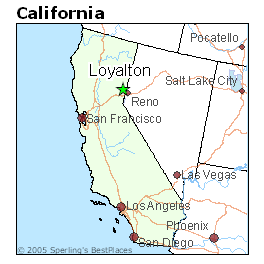
Loyalton, California is a dilapidated mill town in the Sierra Nevada.
The city has four city employees, and the retirees just found out that their pension payments were cut by 60%.
OUCH!
This account first hit the airwaves and the Internet waves in late 2016, about three weeks after President Trump's historic election win!
Only now is the Los Angeles Times reporting on it, though?
Only now?!
Check out the misleading headline for starters:
This tiny Sierra Valley town voted to pull out of CalPERS. Now city retirees are seeing their pensions slashed
The title gives off a thin veneer of heartless disregard for the working people of the city. The truth is far more pragmatic yet tragic at the same time.
Here's the article with my comments:
The tremor in John Cussins’ right hand worsened as he described restless
nights haunted by worries about paying the bills.
Yes, immediately we get the sob story, the tragedy for the retired public employee. This is indeed tragic, in that the local city betrayed their promise to ensure the retirement, the declining years of their employees.
Then again, let's face the facts: elected officials handed out these plum contracts to public employee unions to get votes. Those votes are costing future generations, and all of that comes out of our pockets.
After suffering a stroke in 2012, he retired as a 21-year employee of
the city of Loyalton, Calif., where he oversaw the town’s water and sewer
systems. Cussins, 56, believed his city pension and the Social Security
payments he and his wife received would bring in enough to provide a decent
retirement in the tiny, old timber mill town in the Sierra Valley.
Think this scenario through. Cussins retired at 52. Only 52 years old? Did he really expect to live off a pension paid by taxpayers for the rest of his life? Does anyone not see how insanely unsustainable all of this pension shell-gaming is? The ones getting gamed are We the People. Enough already.
Then a letter arrived in October. The California Public Employees’
Retirement System was cutting his $2,500-a-month pension by 60 percent,
bringing it to about $1,000 a month.
OUCH! What is to be done when your monthly pay is slashed so dramatically?
“I was really shocked when I found out about it,” Cussins said. “We
thought the pensions were there for the rest of our lives.”
There you go, folks. "We thought the pensions would be there forever and ever." You thought wrong, folks. Just because a politician puts his city and its name and charter
Loyalton’s four retired city employees became the first in California
to see their pensions sliced by CalPERS because of a city defaulting on its
payments to the fund, but hundreds of other government retirees across the
state may soon face a similar fate. At the same time, financially strapped
local governments that considered pulling out of the state pension system, some
hoping to find more affordable alternatives, have found it next to impossible
to do because of the large termination fees they must pay CalPERS if they do.
Reminder: This story is at least 8 months old. What took the Los Angeles Times so long to cover this story? These individuals included the retire city librarian. This pension fallout is serious, everyone. Can you imagine all those baby boomers and other recent retirees wondering how they plan on getting through the rest of their not-so-Golden years?
Many of California's retirees need to look at what happened in Detroit, Michigan. The city went bankrupt, and public employees witnessed their pensions slashed. The public sector unions which had promised the goose and the golden eggs now have nothing but goose eggs in hand, and nothing else.
As the nation’s largest public pension fund, CalPERS manages a
$300-billion retirement system that services more than 1.8 million members and
a retiree healthcare program that serves close to 1.4 million more. CalPERS
functions as a money manager, investing the funds paid into the system by state
and local governments. But those governments decide what pension benefits they
will provide their employees and are ultimately responsible for ensuring there
is enough money in their pension funds to provide the benefits promised.
The cities don't have enough money on their own at all. The makers are taking off, fleeing California, and the takers are taking all that they can make off with. Cities have nothing left. More cities want to go sanctuary city, which means more illegal aliens living in the confines, and none of them are paying taxes, all while draining the coffers of the already depleted public welfare programs, the public school systems, and the emergency rooms.
Cussins was a member of the Loyalton City Council when the pensions
were cut, but he said he had no idea it was coming. More than three years
before he was elected, the council voted to pull out of CalPERS when its last
pension-eligible employee retired, deciding the monthly payments were too steep
for a town that for years flirted with insolvency.
This pension tsunami disaster is affecting everyone, old and young, much like the Ten Plagues which struck Egypt during Biblical times.
CalPERS levied a $1.66-million termination fee on the city. Loyalton,
home to about 760 people, has a single full-time city worker and an annual
budget just shy of $1 million. The city didn’t pay the fee, so the four retired
city employees saw their pensions slashed in November.
OUCH! Now the cities can't even get out of paying into a system that they cannot even pay into in the first place. Socialism at its best and its worst: the government has run out of other people's money. California is going to turn into Puerto Rico before it turns in Venezuela.
“I’m scared to do anything. I’m scared to spend much money,” Cussins
said. “I guess worst comes to worst, we’d even have to sell our property and
try to go to some low-income housing deal.”
There you go -- and who is going to buy their property all the way out there in Loyalton, CA? Another pot farm enthusiast, perhaps.
He now has company. The CalPERS Board of Administration in March voted
to cut the pensions of close to 200 retirees from the East San Gabriel Valley
Human Services Consortium, a Southern California job training program created
by the cities of Azusa, Covina, West Covina and Glendora. The agency stopped
contributing to the state pension system when it folded in 2014. On July 1,
CalPERS sliced the pension checks for the consortium’s retirees by 63%.
Wow! This is incredible. More pensions are getting cut. The bleeding has only gotten worse. Six years ago, the state assembly was supposed to be working on reforms to the overdrawn, bloated, entitlement driven pension system.
Retirees of the Niland Sanitary District, just east of the Salton Sea,
could also face action, although the agency is currently negotiating with
CalPERS officials to determine how much it may cost to leave the pension
system.
The Salton Sea is drying up, and so is the pension system for more public entities. The pension shell game was the political confidence game of the ages. Now everyone is getting fooled.
At the center of all of these cases is the termination fee local
governments must pay to CalPERS if they opt to leave the system — money that
officials at the state pension system say is needed to ensure retirees receive
the full pensions they were promised.
Cities don't have the money. The illegals, the welfare queens, and everyone else who voted for a living rather than working for a living will find themselves out of cash.
After the city of Stockton declared bankruptcy in 2012 following the
nationwide recession, the federal court judge handling the case called the fee
a “golden handcuff” and “poison pill” that prevents cities and other local
governments from leaving CalPERS to find other options for employee pension benefits.
The price tag for Stockton to pull out of CalPERS was $1.6 billion. The city
chose to stay put.
Does any city have that kind of money sitting around to dish out? Golden handcuffs is appropriate, but even judges do not have more power than the laws of supply and demand. Bad lawyers in black dresses cannot say to the market system, to the most impoverished of cities that they have to pay up when they have nothing with which to pay. There is no sueezing wine out of turnip, or blood out of stone.
Or much-needed pension money out of a dead-beat city council.
If a city decides to pull out of the state pension fund, CalPERS places
the municipality’s pension fund into a pool of lower-risk investments, which
lowers the return rate on what that city earns. As a consequence of the reduced
investment earnings, the city will have less money to pay the full pension
benefits of its retirees, increasing the termination fee imposed by CalPERS to
make up the shortfall.
Eek. The drain is swirling downward, and fast.
FYI, for my city, Torrance California, the city's budget must allocate 1 out of ever 4 dollars to pensions. That's not good.
Loyalton’s CalPERS account was worth $1.1 million when it voted to pull
out. And when placed in the pool of terminated pension accounts, the city was
expected to earn a 2.4% rate of return on those investments. That rate of
return for Loyalton’s terminated account was far lower than what CalPERS
expects to earn for active pension accounts — roughly 7%.
Even those returns are idealistic. It's not going to happen.
CalPERS spokeswoman Amy Morgan said the agency placed the pool of
terminated accounts in conservative investments as a precaution because CalPERS
would be obligated to cover any shortfall if there was a drop in earnings. That
risk is compounded by the fact that cities exiting CalPERS stop contributing to
the pension system — monthly payments that serve as a buffer to investment
losses and other potential impacts, including inflation.
Wow! Even CalPERS is going bust. Winning!
Close to 100 cities and other government entities have terminated their
CalPERS accounts and, combined, those pension funds create a pool of money that
exceeds $222 million. As of June 2015, the amount CalPERS expected to have to pay
in pensions from that fund was estimated to be $88.5 million — meaning the
pension account had a $111-million surplus, according to a March report.
Sure it does.
Villa Park in Orange County toyed with the idea of leaving CalPERS in
2014, in part because officials wanted to determine the small city’s long-term
pension liability. Former Villa Park Mayor Rick Barnett said other, more
affordable options are available, including deferred compensation plans similar
to a 401(k). But Villa Park opted not to move forward after CalPERS tallied the
termination fee: $3.6 million.
CalPERS enrollment is just like being married to the mob. You're part of the racketeering, and there's not getting out. None.
“It’s a joke,” said Barnett, an Irvine bankruptcy attorney. “You’re
trapped.”
CalPERS warned Loyalton officials about the exit fee back in June 2014
and met with city leaders several times to discuss the consequences. CalPERS officials
said that Loyalton received 10 collection notices before the pensions were cut.
But the retirees said neither the city nor CalPERS warned them that their
pensions were at risk until last fall.
Of course they didn't warn the pensioners. They all would have lost their jobs at the next election. In the next two or three local election cycles, expect to see elected officials stop promising the sun, moon, and stars; but expect them to start making backroom deals to screw over the very public employees who expect full pension and benefits paid for. It's going to be very ugly.
“As a Board, we have a fiduciary responsibility to keep the CalPERS
Fund on secure footing, and as part of this duty we must ensure that employers
adhere to the contracts they agreed to. When they don’t, the law requires us to
act,” said Rob Feckner, president of the CalPERS board, in a statement after the
November decision. “The people who suffer for this are Loyalton’s public
servants who had every right to expect that the city would pay its bill and
fulfill the benefit promises it made to them.”
People can expect anything that is promised to them, but we are living in times were generous contracts are promising something which elected officials, and the taxpayers whom they are expected to represent, cannot afford or provide.
Loyalton City Council members told CalPERS officials in November that
the city would directly reimburse retirees for the pension money they lost —
$5,000 a month for all four retirees combined.
WOW! Now the city of Loyalton has to pay through its own teeth for the pension short-fall. How long will this last? No one should anticipate that Stockton, Los Angeles, or San Francisco to offset the CalPERS pension cuts.
But that promise may be short-lived. The City Council has been
providing those supplemental payments since CalPERS sliced the city retirees’
pensions, and it has voted to continue those payments until November. After
that, the payments may be reduced — or cut off entirely.
It's time for every able-bodied adult to accept the need to work for our living. Millennials and Post-Millennials are well-aware that whatever entitlemnt/retirement programs were laid out 80 years ago are all falling apart.
It's time to stop expecting all of us to pay the Baby Boomers' retirement while cleaning up the Millennials' self-imposed messes. Enough.
Most of Loyalton’s annual budget is dedicated to running the city’s
water and sewer system. The city only has about $160,000 for other expenses,
including paying the Sierra County Sheriff’s Office for police protection, the
salary of the city’s single full-time employee who works inside City Hall and
outside contractors that help run the city. Loyalton only expected to have
$30,000 in reserves, city officials said. Reimbursing the city’s retirees will
cost $60,000 a year.
It's over. It's o-o-over.
Loyalton Mayor Mark Marin knows the math won’t work. The son of the
former town fire chief, Marin spent most of his life logging in the Sierra
Nevada until he said he was talked into running for mayor just over a year ago,
adding that he only ran for City Council to help untangle the city’s financial
mess.
He probably wishes that he didn't run for office at all at this point.
“I don’t know where we’re going to get the money unless we start
selling crap off,” Marin said. “What’ll end up happening is that we won’t be
able to pay our obligation and the retirees will come back with a lawsuit. The
only way they’re going to get any money is if they take property. It’s a
Catch-22.”
Once again, laws and legal challenges do not produce money that is simply not there. What's next? The city declares bankruptcy, and no one gets anything.
Marin noted that it would have been a lot cheaper if the city had just
stayed in CalPERS. Loyalton was paying just $3,500 a month, and that covered
the cost of its retirees’ full pensions.
Once a proud and vibrant company town known for solid-paying jobs and a
frontier lifestyle, Loyalton was flattened in 2001 when Sierra Pacific
Industries — the largest employer in Sierra County at the time — shut down the
sawmill that sustained the town for more than a century.
How about that? The manufacturing jobs left the area. Then everything went down hill. Will blue collar jobs ever come back to California?
And more recently, Loyalton has been bitten by a series of
self-inflicted financial blunders and misfortune.
In 2014, a Sierra County grand jury issued a scathing report that
detailed a litany of mismanagement issues in the city. It found some members of
the City Council were “less than honest” and questioned whether the city would
survive financially.
"Less than honest"--I wonder what the Los Angeles County Grand Jury would say about Los Angeles City or other corrupt municipalities around the country.
“The City, through its City Council, has decided that amateurs know the
best way to run the city, and this is causing problems that are starting to
show up. This is exposing the citizens of the city to liability issues in many
forms and from many sources,” the report stated.
In 2010, the city’s bookkeeper was arrested and charged with embezzling
public funds. The FBI was called in to help sift through the city’s tangled
finances.
Ouch! Big Trouble in Little Loyalton.
Around the same time, Loyalton’s city employees received a big raise —
close to 50 percent. Explanations for how that happened differ. Marin says it
was knowingly approved by a former City Council. But Councilman Brooks
Mitchell, who was on the council when the raises went through, insists that he
and his colleagues approved only a 5% raise and that the figure was
mysteriously switched to 50% after the vote. It took years for city officials
to notice, Mitchell said.
Ha!
Mitchell figures that mistake cost the city more than $650,000, though
Loyalton’s insurance policy allowed the city to recoup about $330,000.
But that pot of money disappeared fast. The council spent a chunk to
convert an old elementary school into a new home for Loyalton’s City Hall and
the town museum in 2015. It also spent more than $20,000 on a pair of engraved
stone signs to welcome visitors to Loyalton.
Reckless spending abounds in all cities.
“The City Council went overboard. They got all this money back from the
insurance and started spending everything. Then, later on, they cut our
retirement,” said Patsy Jardin, 71, who worked for the city for three decades
as the City Hall office manager and bookkeeper.
Jardin said her $4,100 monthly check from CalPERS was slashed by close
to $2,000 after the City Council voted to pull out of the pension fund in 2012.
The council “promised me it wouldn’t cut my retirement,” Jardin said.
“They promised me.”
Corruption and mismanagement are everywhere, people, in small cities as well as large ones. Pay close attention to the people whom you elect to your local governing boards. Their decisions matter.
Loyalton’s mayor said there’s no doubt the city messed up by granting
pension benefits without thinking hard about whether the small town could pay
for them down the line. But, he said, Loyalton’s predicament is just a symptom
of a overly generous state pension system that has become unsustainable.
WOW! The city council did not think about the long-term costs of handing out lavish pensions?! No kidding! Incredible.
“There are people who made $200,000 a year and they’re drawing $200,000
in retirement,” Marin said. “How’s that going to work?”
It's not working--and it never will.
Final Reflection
When it comes to the looming pension crises ... there will be blood, and the politicians will be drinking your milkshake.