Showing posts with label Jesus. Show all posts

Saturday, January 13, 2024

LOTR: The Return of the Rings, Revisited and Revealing

A few months ago, I wandered into aFacebook fan page for the Lord of the Rings trilogy, the films directed by Peter Jackson.

Wow, what a great set of films they were! I had not appreciated how good they were. Indeed, The Return of the King deserved to win the 2004 Academy Award for Best Picture.

It's a really moving series, a powerful fantasy, excellent movie-making. The source material from J.R.R. Tolkien is high-quality stuff to begin with, and the actors and director magnified its beauty, wonder, and wit. There were so many opportunities for the film to fail, to become too schmaltzy or cloistered in a world of petty fandom. Instead, this film resonates on many eternal themes, and showcases that even in great victories there are still failing characteristics which all of us must overcome.

For all of its whimsy, "The Lord of the Rings" movie trilogy speaks to real hearts and real minds, does not insult viewers. The playful antics of the Hobbits, coupled with the raw emotions of human beings and other fairy-like creatures, appeal to all audiences.

I took the time to watch all three movies over the last few weeks (including over the Christmas-New Years break), and I was really impressed with the whole production.

One of my favorite quotes from the trilogy takes place in the midst of the musing fears and comforts between Samwise Gamgee and Frodo Baggins toward the end of "The Two Towers":


I love this quote, and I have been sharing it often.

But now, I want to focus on the final film in the trilogy "Return of the King," and specifically the final scenes.

Frodo Baggins and his fellow Hobbits return to their homes in The Shire. They see all their friends, family, and neighbors whom they have known for years.

When they return to the local pub to drink a pint, however, their is a marked, saddened sobriety in their bearing, in their actions. Life is completely different for them, especially Frodo. They journeyed all over Middle Earth, they fought some of the greatest forces in that world, they defeated the most formidable foe--Sauron--and they overcame some of their own vices and limitations to accomplish those deeds. They received consummate honor for their sacrifices, too.

Who can forget Aragon, the rightly crowned king of Minas Tirith, telling the four Hobbits: "My friends, you bow to no one!" Amazing. After such powerful and moving service to their countrymen and to the world at large, one would think they would be received with greater aplomb.

Yet that does not happen. Instead, all the other Hobbits in Hobbiton go about their little lives, enjoying simple pleasures, not realizing how big, grand, amazing, and even intimidating the world can be, and not understanding not appreciating (or rather, being able to appreciate) the incredible good that Frodo and his Fellowship achieved for them.

Who can go quotidian routines after having done so much unprecedented good?

This revelation really spoke to me, and one of the last lines in the film encapsulated this sentiment for me:


You can see the whole scene here.

Not only do Gandalf, Elrond, and the other creature-heroes of Middle Earth leave for the West, but so does Frodo. There is nothing left for him in Middle Earth, in the Shire. He has changed dramatically so, he has grown, he has seen things about himself, much good and even some not so good, and that revelation has transformed everything for him.

He left the Shire, and he cannot go back to the way things were.

There is one commentary on this scene which casts a particularly negative interpretation on the exchange between Frodo and Samwise:

Tolkien wrote: “We are finite creatures with absolute limitations upon the powers of our soul-body structure in either action or endurance. Moral failure can only be asserted, I think, when a man’s efforts or endurance falls short of his limits, and the blame decreases as that limit is closer approached.”

So no blame is attached to Frodo by any other person except for the blame that he attaches to himself but that is sufficient for Frodo to experience both judgement and punishment.

Tolkien addresses this with wonderful sensitivity in his letter.

The main thrust of this article is that Frodo is leaving Middle Earth to atone for his failure to get rid of the Ring of Power completely on his own. The main argument is that Frodo is not fit for his homeland because in a sense, he failed them.

I do not accept this view.

What I see is a Hobbit, a youth who has matured through great trial, one who sees everything so differently, more profoundly than before, and who can never quite fit in with the surroundings and personalities of his younger days, before he ventured to Mordor to get rid of the Ring.

Now that Frodo has changed, now that he has grown, he has to move on. 

This revelation speaks to me because I have experienced this similar transformation in my life. Over the last few months particularly, I have found myself no longer interested in going to the same haunts, same events with people whom I have known, whom I befriended long ago. We don't share the same values, views, or goals anymore. I have been really growing in grace as I see more of Jesus in God's Word, as I understand more of the abuse and pain I went through when I was younger, and now that I am older and wiser, I can see things more clearly.

How I related to people in the past, and many of the activities and efforts I invested in in the past, no longer matter that much to me. Some friendships I have given up, seeing how those individuals have not grown up, do not see more, have no interest in trying new things or obtaining greater revelation of the truth.

It's painful to part ways with people whom you have known for so long, yet you find that there is little else to know, and you have come to see, understand, perceive, and discern so much more than they have, and more than they care to learn about. Yet there is great peace in understanding that the pain of parting ways with others, with familiar faces and places, is inevitable, and an inevitable good. It means that I am growing, changing for the better, something that I have consistently prayed for in my life.

This powerful revelation really shook me, and I am so grateful to have rewatched not just the Lord of the Rings Trilogy, but to appreciate the final goodbyes of Frodo Baggins in that final scene.

Tuesday, November 22, 2022

Why Abused Children Hate Themselves, Not Their Parents

 From "The School of Life":

Why Abused Children End Up Hating Themselves

There is almost nothing sadder in the universe than the abuse of a child by its own parents. That a being should be put on earth in an entirely helpless state, then maltreated by those to whom it automatically turns for protection and education, constitutes a particular abomination.

What I am starting to learn more and more every day is that abuse in the household is more common than I realized. It's really sad, but it seems that family dynamics are more riddled with tragedy that joy. I don't want to accept this fallen aspect of our fallen world, but unfortunately, the stain of sin has ruined everything, including family relationships.

God wants all families to prosper and be in health, but these families need to receive the revealing favor of the Savior!

One of the people who can best help us to understand the way a child typically responds to abuse is a little known and too often underestimated Scottish 20th century psychoanalyst, Ronald Fairbairn. Fairbairn was touchingly honest about what had brought him to psychoanalysis: he was not well. He had a bad relationship with his mother; he had a cold marriage, he had a range of anxieties and phobias. But as he put it himself: ‘It is difficult to see what inducements to seek psycho-analytical treatment there could be for an adult with a relatively mature, strong and unmodified ego.’ In other words, only fairly disturbed people are ever likely to get interested in psychoanalysis, let alone submit themselves to a training. And that is fine - and no argument against anything.

Ronald Fairbairn


Fairbairn came to his views about how the victims of parental abuse interpret what has happened to them as a result of working as a doctor at the University of Edinburgh’s Psychological Clinic for Children in the late 1930s. In his post, he came into contact with many children who had been extremely badly treated in their homes of origins. What he found - and what profoundly struck him - was how little these children appeared to hold the abuse against their parents. Some had been appallingly mocked, others badly beaten, others sexually abused. One might have expected that the children would, in the safety of a doctor’s consulting room, voice grave misgivings and rage against those who had treated them so unfairly. But Fairbairn found no such thing. 

Contrary to all expectations, the children he spoke to had only positive things to report about those who had - to a substantial degree - ruined their lives. A violent father would be described as strong and decisive: a cold and contemptuous mother would be re-interpreted as kind and intelligent. And correspondingly, a child would pour all the negativity that one might have assumed belonged elsewhere onto their own shoulders: they were the bad one, they had clearly been naughty, there was something intolerably wrong with them - and that is why they had been punished.

Children have no one else to look up to besides their parents, when they are children. If they do not have their parents to look up to, whom do they look up to? The identity crisis, the emotional trauma is too great without that sense of core identity. People will tolerate abuse over anxiety every time, and for children that is all the more the case.

What Fairbairn beautifully and poignantly understood was that the abused child has no option to think of themselves in decent terms. The truth is quite literally unbearable and must be twisted. One could not continue to live, as a defenceless child, if one fully took on board the evil that has been visited upon one. And therefore the mind alters the facts in the name of psychic survival.

In perhaps his most brilliant, paper, The Repression and the Return of Bad Objects first published in 1941, Fairbairn tried to show the reader the perverse but highly understandable logic operating in the abused child’s mind.

‘If a mature individual loses an object,  however important, he still has some objects remaining. His eggs are not all in one basket… The infant, on the other hand, has no choice. He has no alternative but to accept or reject his object - an alternative which is liable to present itself to him as a choice between life and death.’

There are no other parents that the child in an abusive family are able to run to: he has no other mother or father, the neglectful and harmful people in the vicinity are the only figures he has to cling to. Lose faith in them and one is done for. No wonder if one opts to reinvent who they might be.

At this point, Fairbairn is wrong. Everyone of us can run to the perfect loving FATHER! We received sonship before Him through Christ Jesus. AMEN!

Fairbairn famously called this manoeuvre of the mind ‘the moral defence,’ an attempt to exonerate the abuser and chastise oneself for one’s own abuse. In the words of one of Fairbairn’s most sensitive later interpreters, the American therapist and writer David Celani: ‘The moral defence is a source of comfort, as it reassures the child that he is being appropriately corrected by loving objects… the illusion that the child is securely attached to good objects prolongs his hope that his unmet developmental needs have a chance of being satisfied and that the feeling of abandonment will be avoided.’

One of the more striking features of Fairbairn was that he remained throughout his life a religious person, as so few of the great figures of psychoanalysis have been. Far from a distraction, this theological background gave Fairbairn a way of conceptualising a child’s response to abuse in terms of a form of faith. In a memorable aphorism, he wrote: ‘It is better to be a sinner in a world ruled by God than to live in a world ruled by the Devil.’ By this Fairbairn meant that the child prefers to think of themselves as still inhabiting an essentially ethical responsible realm, one in which they have transgressed and must be punished - but where the authority figures remain pillars of decency. As he went on to explain: ‘A sinner in a world ruled by God may be bad; but there is always a certain sense of security to be derived from the fact that the world around is good… there is always a hope of redemption.’ One shudders at the pain that makes this kind of mental gymnastics necessary.

We have to receive a larger revelation. The world is bad, our parents may have been bad, but God is GOOD! The Lord is GOOD and His mercy endures forever! Every one of us needs to receive this revelation. We need to be transformed from glory to glory by seeing more of Christ Jesus, and the Holy Spirit changes us! Our minds are renewed to the truth that though we were harmed as children, it was not our fault, and our parents were wrong, believed wrong, did wrong, or they chose to do wrong -- but none of that makes us wrong.

Fairbairn’s view of what psychoanalysis can do for an abused child who has fallen for ‘the moral defence’ is contained in one especially gnomic sentence: ‘The psychotherapist is the true successor to the exorcist,’ he wrote, because ‘he is concerned, not only with ‘the forgiveness of sins’, but also with ‘the casting out of devils.’

What did Fairbairn mean? The answer takes us into the heart of Fairbairn’s innovations in what psychoanalysis calls object relations. For Fairbairn, the bad external object (the abused parent) is quite literally internalised by the child and thereby turns the child into a bad object in their own eyes. All the violence of which they, the child, have been subject ends up in them and then colours their internal world. How they feel about themselves becomes a mirror of how others felt about them. Their sense of self, made up as it is of the introjections of parental messages, becomes a panoply of darkness and masochism.

Fairbairn proposed - counter to a lot of psychoanalytic thinking at the time - that the primary instrument by which ‘the devils’ inside the ill patient’s mind were to be exorcised was through a clinically much-neglected quality: kindness. By registering the analyst’s unusual kindness and empathy, the patient might be induced to loosen their hold on the moral defence and cease to think of their parents as so good, and themselves as so bad. They might - through love - come to be a little more on their own side and a little less on the side of their abusers - and thereby save their lives.

I have another word for kindess: GRACE!

Fairbairn described a patient of his called Annabel who had developed a phobia about driving. Every time she was at the wheel, she became terrified that she might inadvertently hit someone and leave a trail of corpses behind; the terror forced her to pull up and walk home. In her sessions with Fairbairn, Annabel came to see that her phobia was the result of a suppressed rage against her father, an outwardly respectable and highly successful man, who had in early childhood behaved incestuously towards her. Consciously, Annabel had only positive feelings towards her father. Unconsciously, it was far more complicated. Annabel had come to be frightened of herself at the wheel (and in other areas too; her self-suspicion was vast) in lieu of properly appreciating how unfair and depraved her own father had been towards her. Fairbairn noted that many of his patients were suffering from symptoms essentially caused by incestuous wishes of their fathers which they had been unable to understand or address, and that had morphed into self-hatred and paranoia. Fairbairn gives us a penetrating analysis of paranoia: the entire world will grow filled with dangers when we cannot repatriate the violence and nastiness of which we have been unknowing victims.

People hate their parents for the wrong that they did to them, but at the same time, there is this incredible guilt about being angry with one's parents. We need to see the Grace of God filling in all that hurtful places in our lives, setting us free from the wrong believing. 

We need to receive more of the LOVE OF THE FATHER!

We hear a lot about entitled people; people who take more than their due, who are unfair to the world and deserve to be taken down a peg. What we hear less about are people whose sufferings stem from an opposite problem: they lack the courage to fight back against those who do them wrong and cannot imagine that someone else might be a perpetrator of injustice. Sometimes, to cast out the devils inside us, we may need some help in spotting the devils - or, more appropriately, the extremely ill figures - in our own families. For this, Fairbairn is a supreme guide and mentor.

Monday, November 21, 2022

Karens of the View Spout More Heresy: "Jesus Would Have Led a PRIDE Parade"


These hateful, hackful Karens on The View are a self-parody in embarassment and stupidity.

Do these women even take themselves seriously?

Sunny Hostin, the same black supremacist huckster who called white women "cockroaches" and shamed and denigrated blacks, Hispanics, and Asians for voting for Republicans, took her ranting stupidity to a whole new low.

Check out her latest feast of folly here:

She actually believed that Jesus would be heading a PRIDE parade.

First of all, she talks about Jesus as if He is not alive. That shows right away that she really does not believe in Him.

Second, pride is a sin, the very sin which kicked Satan out of heaven, and which is certainly put the View harpies on a fast-track to hell. 

Last of all, I was really glad to see all the View Karens losing their peace over the fact that people are pushing back against the whole LGBT agenda. They were clearing losing their minds over the fact that the general public is getting tired of homosexuality and transgenderism being normalized in the public square. They are tired of the privileges accorded to homosexuals and transgenders, when such behaviors are not identites, but aberrant maladjustments.

Despite the clear election disappointments earlier this month, there are cultural wins taking place across the country, and the fact that legacy media and talking heads are losing composure shows that they are losing the cultural power they thought they held so closely, so tightly, so perfectly.

I am glad to see that the left-wing Karens of ABC are freaking out about the push-back against LGBT "rights." That's why Sunny "Black Supremacist" Hostin went all in on defaming Christ Jesus, claiming that He would lead a PRIDE parade! How stupid can these silly women be?

Thursday, September 15, 2022

Dear Messianic Jews: We Are No Longer Law, But Under Grace, No Longer Moses, but JESUS


I have found that a number of Messianic Jews believe in Jesus, but in some ways they hold to Moses.

They are standing on both Sinai and Mount Zion. Many other types of Christians have this problem, too. Indeed, we are saved by grace through faith, and because we are dead the law, we become alive in Christ, and thus we are no longer under law!

And yet, there are Messianic Jews which still follow Sabbath on Saturdays and follow the dietary laws out of "obedience to God." That is wrong believing.

Consider one example of this Galatian error in Rabbi Eric Tokajer:

What Shabbat and Adultery Have in Common 

He shares in his article (link above) that he still follows the commandments Moses laid out, even when he was confronted by another Christian about this.

Here are his final thoughts on the matter:

I ended our conversation by letting him know that Messianic Jews, just like all other believers, trust only in Yeshua’s atoning sacrifice for our salvation. Also, just like other believers, after making the choice to accept Yeshua as our Messiah, we also make the choice to do all we can to live our lives according to the commandments G-D has given us, which include loving G-D, loving our neighbors, keeping Shabbat, and not committing adultery.

So as you see, Shabbat and adultery are both commandments from the Torah and they are both commandments that are possible for a believer to obey while not being legalistic.

"Living by the commandments from the Torah" is going back under law. 

No, we are no longer under law, but under grace! That is not an invitation to sin, of course!

Here's the extensive response that I shared with Rabbi Eric

Dear Eric: 

I read your latest article about the Sabbath and Adultery. The Christian who confronted you about keeping the Sabbath was actually correct, but he was also wrong. Regarding the Sabbath, Paul takes care of this pretty simply: "Let no man therefore judge you in meat, or in drink, or in respect of an holyday, or of the new moon, or of the sabbath days:" (Colossians 2:16) 

If your day of rest is Saturday because you choose it, then so be it. But if you are trying to keep Moses' law for sanctification (even if not for justification), that is wrong: "Therefore by the deeds of the law there shall no flesh be justified in his sight: for by the law is the knowledge of sin." (Romans 3:20) and "Moreover the law entered, that the offence might abound. But where sin abounded, grace did much more abound:" (Romans 5:20) The law was never designed to help us, but rather to show us that we are helpless. When we receive Jesus, we are no longer under law (cf Romans 7) 

Your friend had a point, somewhat that there are two commandments that we are instructed to keep, but he then cited The Shema. The fact is that there are two commandments that we keep, but it's a RESULT of God's grace working in us through Christ Jesus. We don't keep them to stay right with God, but as a response to allowing His life to work in us (Philippians 2:12-13) Consider what Jesus said to His disciples on the night that He was betrayed: "A new commandment I give unto you, That ye love one another; as I have loved you, that ye also love one another." (John 13:34) Before that, Jesus had told the Israelites of during His eartlhy ministry: 

"Jesus answered and said unto them, This is the work of God, that ye believe on him whom he hath sent." (John 6:29) 

And John summarizes these two new commandments perfectly: 

"And this is his commandment, That we should believe on the name of his Son Jesus Christ, and love one another, as he gave us commandment." (1 John 3:23) 

Eric, when we are born again, we are DEAD to the law, and we live under grace: 

"Wherefore, my brethren, ye also are become dead to the law by the body of Christ; that ye should be married to another, even to him who is raised from the dead, that we should bring forth fruit unto God." (Romans 7:4) 

and also 

"For I through the law am dead to the law, that I might live unto God." (Glatians 2:19) 

and 


"13And you, being dead in your sins and the uncircumcision of your flesh, hath he quickened together with him, having forgiven you all trespasses; 14Blotting out the handwriting of ordinances that was against us, which was contrary to us, and took it out of the way, nailing it to his cross; 15And having spoiled principalities and powers, he made a shew of them openly, triumphing over them in it." (Colossians 2:13-15) 

and 

"Knowing this, that the law is not made for a righteous man, but for the lawless and disobedient, for the ungodly and for sinners, for unholy and profane, for murderers of fathers and murderers of mothers, for manslayers," (1 Timothy 1:9) 

The Shema is part of the law, and I must ask you: "Have you loved God with all your heart, mind, soul, and strength? No one has, and no one can. We need the Holy Spirit to let His love shed abroad in our hearts to lead us (Romans 5:5) 

Then the next question emerges: How then do we live? By the grace of God! 

"11For the grace of God that bringeth salvation hath appeared to all men, 12Teaching us that, denying ungodliness and worldly lusts, we should live soberly, righteously, and godly, in this present world; 13Looking for that blessed hope, and the glorious appearing of the great God and our Saviour Jesus Christ; 14Who gave himself for us, that he might redeem us from all iniquity, and purify unto himself a peculiar people, zealous of good works." (Titus 2:11-14) 

It is essential that we settle on this effectively. The more that Christians try to keep the Ten Commandments, they are right back to their self-efforts, and such efforts bring forth sin! Not because the law is bad, but because there is no good thing in our flesh (Romans 7:18) It's time to leave Mount Sinai and come to Mount Zion fully, my friend! 

Thank you for your time, and may the LORD JESUS bless you and keep you.

Sincerely,

Arthur Schaper


Wednesday, May 18, 2022

Escape to Reality: Doers of the Law Will be Justified?


Doers of the Law Will be Justified?

What does Romans 2:13 mean?

Was the Apostle Paul confused when he wrote Romans 2:13? Because this verse doesn’t seem to belong in the Bible:

For it is not the hearers of the law who are just before God, but the doers of the Law will be justified. (Romans 2:13)

Doers of the law will be justified?!

Was Paul having a senior moment? Did he forget to insert the word NOT?

There is an easy explanation for this strange verse, which we’ll get to in a minute. But first, let’s be clear: we are justified by faith alone and NOT by keeping the law.

Since we have been justified by faith, we have peace with God through our Lord Jesus Christ. (Romans 5:1)

Justification by faith is one of the great themes of Paul’s writing. Again and again, he reminds us that we are justified or made right with God through faith in his Son (Rom. 3:28, Gal. 3:24).

Since we are justified by faith, and the law is not of faith (Gal. 3:12), no one can ever be justified by keeping the law.

By the works of the Law no flesh will be justified in his sight. (Romans 3:20)

And one more time for emphasis:

We know that a person is not justified by works of the law but through faith in Jesus Christ. (Galatians 2:16)

Paul could not be any clearer. We’re justified by faith not law. Try to impress God with your law-keeping, and you’ll fall from grace and cut yourself off from Christ:

You have been severed from Christ, you who are seeking to be justified by law; you have fallen from grace. (Galatians 5:4)

So with such a clear message (faith, not law), why does Paul say doers of the law will be justified?

Doers of the law

Paul was not saying, “Try and keep the law and you will justify yourself before God,” for that would contradict what he says elsewhere about being justified by faith.

He was saying, “hearing the law is not enough, you have to keep it – and none of you can!”

In context, Paul was speaking to people who knew the law (Rom. 7:1). Like many believers, they had been raised on a diet of rules. They thought if they heard the rules, studied the rules, and hung them on their walls, God would be impressed.

Nope.

Going to church and hearing the rules is not enough.

Teaching the rules and condemning those who break them is not enough.

Lobbying for God’s law to be hung on courthouses is not enough.

You have to keep all the rules and no one can.

It is impossible for imperfect man to deliver a lifetime of perfect performance. Paul is not calling us to attempt the impossible; he’s trying to get us to admit defeat.

Doers of the law will be justified, but you are not and never can be a doer of the law.

There was only one Doer of the law who was made right with God and that Doer offers you his righteousness as a free gift.

So then, the law was our guardian until Christ came, in order that we might be justified by faith. (Galatians 3:24)

To be justified means God has judged you righteous and not guilty of sin. To be justified is to be made right with God.

You cannot earn the gift of righteousness and you cannot justify yourself before God. The only thing you can do is receive his righteousness by faith.

Want to get right with God?

Start by thanking him for Jesus who was made sin so that you might be justified and made righteous (2 Cor. 5:21).

You are not justified or made right with God because of anything you do, but because of everything he has done.

—–

Want to learn more about justification, righteousness, and the law? Check out our ever-expanding Grace Glossary.

Read more articles and these frequently-asked questions about the law.

Sunday, May 8, 2022

Sermon: Enlightened, Transformed, Healed by Beholding Jesus in the Word


Thank you, Pastor Gordon and the rest of the pastoral team for letting me speaking to the whole church today.

I really appreciate it!

All of this started out with the blessed opportunity to share a great testimony, which I will share again.

Thursday, April 21, I had a stroke! I am only 41 years old, and I had a stroke! I suddenly had trouble swallowing, and I felt numbness along the right side of my body. When I called 9-11, I could not speak or saying anything intelligible.

But instead of panicking or getting afraid, I remembered God’s Word, God’s promises for me, and I declared in my mind, even if I could not say it out of my mouth:

“I shall not die, but live, and declare the works of the LORD.” (Psalm 118:17)

I have a picture on my door at home, and I declare another promise, that I will live to be 120 years old. That’s a promise we can bank on because of these verses:

“And the LORD said, My spirit shall not always strive with man, for that he also is flesh: yet his days shall be an hundred and twenty years.” (Genesis 6:3)

The second time that 120 is mentioned, as in 120 years, takes place in Deuteronomy, when Moses dies:

“And Moses was an hundred and twenty years old when he died: his eye was not dim, nor his natural force abated.” (Deuteronomy 34:7)

We can rest and receive this promise, because of what God has done for us through His Son Jesus!

Consider the last verse in Psalm 91:

“With long life will I satisfy him, and shew him my salvation.” (Psalm 91:16)

That last word says it all: Salvation!

We can trust and believe for long life, because of Jesus! He is our Life:

“When Christ, who is our life, shall appear, then shall ye also appear with him in glory.” (Colossians 3:4)

So, when I had my stroke, I called 911, and paramedics arrived on scene to assist me. By the time they arrived, all the symptoms were gone. I could talk, I could drink, and I felt no numbness in the right side of my body. They told me to go to urgent care, which I did. The doctor told me “You’re going into emergency. This is very serious. It’s better to have long period of aggravation than to take a chance, suffer later.”

So, there I was in the emergency room. And then they told me that I was going to stay for the evening. They didn’t know why I had a stroke. My blood pressure was OK, and they did some initial scans, and they found evidence of a suspected stroke. But that was it.

While I was in the hospital room, I started praying the first prayer that Paul the Apostle shares with the Ephesians church. That has been a prayer that I have been praying a great deal for the last year and a half:

“15Wherefore I also, after I heard of your faith in the Lord Jesus, and love unto all the saints, 16Cease not to give thanks for you, making mention of you in my prayers; 17That the God of our Lord Jesus Christ, the Father of glory, may give unto you the spirit of wisdom and revelation in the knowledge of him: 18The eyes of your understanding being enlightened; that ye may know what is the hope of his calling, and what the riches of the glory of his inheritance in the saints,” (Ephesians 1:15-18)

I want to see more of Jesus! I want to see Him!

I want to share with you the New Living Translation of Ephesians 1:18:

“I pray that your hearts will be flooded with light so that you can understand the confident hope he has given to those he called—his holy people who are his rich and glorious inheritance.” (Ephesians 1:18, NLT)

In these really tough times, when there are troubles on every side, it’s so important to see Him!

Jesus is alive! He is alive in our everyday lives, because He is our life. I feel that many believers in the Body of Christ know that Jesus died for them, but they don’t see Him as a living, moving, active Savior in every day of their walk on this earth.

Now, the question comes up: how do I see Jesus? What is the best way to see Him?

Jesus Himself provides the way!

Turn with me to Luke 24: [Spence, I will tell you how to bring up the verses, one at a time---Luke 24: 13-24]

“13And, behold, two of them went that same day to a village called Emmaus, which was from Jerusalem about threescore furlongs. 14And they talked together of all these things which had happened. 15And it came to pass, that, while they communed together and reasoned, Jesus himself drew near, and went with them.” (Luke 24: 13-15]

Check that out! Jesus HIMSELF! Drew near!

 16But their eyes were holden that they should not know him.

Some people have suggested that Jesus withheld the two of them from seeing Him. I don’t receive that, because Jesus is the Light of the World (John 8:12). I will explain later why I think these two disciples did not recognize Jesus at first.

17And he said unto them, What manner of communications are these that ye have one to another, as ye walk, and are sad? (Luke 24:17)

I want to park here for a second. Notice how Jesus, who has risen from the dead, purged all our sins, fulfilled so many prophecies, steps into the life of these two downcast disciples. He cares for your, believers, and now matter how bad the situation may seem, Jesus is there with you!

18And the one of them, whose name was Cleopas, answering said unto him, Art thou only a stranger in Jerusalem, and hast not known the things which are come to pass there in these days? 19And he said unto them, What things? And they said unto him, Concerning Jesus of Nazareth, which was a prophet mighty in deed and word before God and all the people: 20And how the chief priests and our rulers delivered him to be condemned to death, and have crucified him. (Luke 24:18-20)

Notice how Cleopas refers to Jesus as a prophet. Yes, He served as a prophet during His earthly ministry. But Jesus did not come to earth to reveal God’s judgment against us, nor to remind everyone of their sins. He came to become sin, that we might be made the righteousness of God in Him.

The fact that Jesus was crucified, the worst death imaginable, was a really crushing blow to the disciples. And why?

21But we trusted that it had been he which should have redeemed Israel: and beside all this, to day is the third day since these things were done. 22Yea, and certain women also of our company made us astonished, which were early at the sepulchre; 23And when they found not his body, they came, saying, that they had also seen a vision of angels, which said that he was alive. 24And certain of them which were with us went to the sepulchre, and found it even so as the women had said: but him they saw not.” (Luke 24:21-24)

Notice that the disciples major focus is Israel. They saw Jesus as a means to an end. They saw Jesus as a political Messiah who would restore the glory of Israel. Don’t get me wrong. Israel is being restored right now, and when Jesus comes back, He will be reigning from Jerusalem.

But the focus is on Jesus, on Himself!

And Jesus gently corrects them:

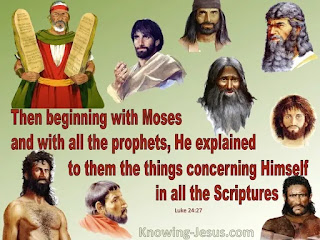
25Then he said unto them, O fools, and slow of heart to believe all that the prophets have spoken: 26Ought not Christ to have suffered these things, and to enter into his glory? 27And beginning at Moses and all the prophets, he expounded unto them in all the scriptures the things concerning himself.” (Luke 24:25-27)

When Jesus opened the Scriptures to the two disciples on the road to Emmaus, He taught of HIMSELF!

He didn’t talk about having a good marriage, or how to improve your bank account, or how to get healing. He didn’t even talk about how to have great faith. Jesus is not a means to an end. He is the means and the end. He declares the end from the beginning. It’s all about Him!

He taught of Himself!

We want to be caught up in Himself! We want to see more of Himself! It’s all about Him!

“15Who is the image of the invisible God, the firstborn of every creature: 16For by him were all things created, that are in heaven, and that are in earth, visible and invisible, whether they be thrones, or dominions, or principalities, or powers: all things were created by him, and for him: 17And he is before all things, and by him all things consist. (Colossians 1:15-17)

Peter’s last words in the New Testament are:

“But grow in grace, and in the knowledge of our Lord and Saviour Jesus Christ. To him be glory both now and for ever. Amen.” (2 Peter 3:18)

Paul was really clear about his focus when he ministered to the Corinthian church:

“For I determined not to know any thing among you, save Jesus Christ, and him crucified.” (1 Corinthians 2:2)

I used to struggle with this verse, because it seemed to impractical to me. When Paul says that he knew nothing among them but Christ and Him Crucified, I immediately start asking “But how does that help me with this problem or that problem? What I am supposed to do with myself, with my life?”

The mistake that I made was thinking that Paul was talking about Jesus as though He is some static figure. But Jesus is alive, active, working in our lives, working behind the scenes caring for us! When we see Him in the Gospels, we see a living Savior who provides for our needs, who over-answers our prayers! (Ephesians 3:20)

He is the same yesterday, today, and forever (Hebrews 13:8)

Now, I mentioned above how Jesus taught of Himself. He didn’t teach about faith, did He? It’s not that faith is not important.

But how do we get faith?

“So then faith cometh by hearing, and hearing by the word of God.” (Romans 10:17)

That’s the KJV, but let’s take a look at the NIV:

“Consequently, faith comes from hearing the message, and the message is heard through the word about Christ.” (Romans 10:17)

And here’s the American Standard Version:

“So belief cometh of hearing, and hearing by the word of Christ.”

The original Greek reads “Rhema Christou.” It’s the Word of Christ, not the Word of God. We want to see everything in the Word through the Finished Work of JESUS! We need to see everything in the Word, from Genesis to Revelation, through the lens of the New Covenant, in which Jesus has paid for all our sins, and brings us into a New and everlasting covenant.

Let me take a little time to share with all of you what is in the New Covenant. We are all hearing about it, but what does it actually say?

“10For this is the covenant that I will make with the house of Israel after those days, saith the Lord; I will put my laws into their mind, and write them in their hearts: and I will be to them a God, and they shall be to me a people:

11And they shall not teach every man his neighbour, and every man his brother, saying, Know the Lord: for all shall know me, from the least to the greatest.

12For I will be merciful to their unrighteousness, and their sins and their iniquities will I remember no more.

This new covenant is all about what God does. It’s not about us keeping commandments, following the steps, but believing in Him, that Jesus has taken all our sins and has justified us, brought us into right relationship with God the Father, our Father!

Jesus himself—there’s that “Himself” again!—said to the Israelites during His earthly ministry:

“Jesus answered and said unto them, This is the work of God, that ye believe on him whom he hath sent.” (John 6:29)

We have to rightly divide the Word of Truth (2 Timothy 2:15)!

There are some passages in which God declares to the Israelites:

“I, the Lord thy God, am a jealous God, visiting the iniquity of the fathers upon the children unto the third and fourth generation of them that hate Me,” (Deuteronomy 5:9)

But that’s the Old Covenant! We are now longer under law, under the Old Covenant, but under grace, under the New Covenant! (Romans 6:14)

“Who his own self bare our sins in his own body on the tree, that we, being dead to sins, should live unto righteousness: by whose stripes ye were healed.” (1 Peter 2:24)

And

“For he hath made him to be sin for us, who knew no sin; that we might be made the righteousness of God in him.” (2 Corinthians 5:21)

Under the Old Covenant, God will curse those who don’t keep the law:

“Cursed be he that confirmeth not all the words of this law to do them. And all the people shall say, Amen.” (Deuteronomy 27:26)

But under grace, under the New Covenant:

“10For as many as are of the works of the law are under the curse: for it is written, Cursed is every one that continueth not in all things which are written in the book of the law to do them. 11But that no man is justified by the law in the sight of God, it is evident: for, The just shall live by faith. 12And the law is not of faith: but, The man that doeth them shall live in them. 13Christ hath redeemed us from the curse of the law, being made a curse for us: for it is written, Cursed is every one that hangeth on a tree: 14That the blessing of Abraham might come on the Gentiles through Jesus Christ; that we might receive the promise of the Spirit through faith.” (Galatians 3:10-14)

Whenever we open up the Scriptures, we want a revelation of Jesus, our Messiah, who suffered, died, was buried, rose from the dead for our justification, and who ministers for us after the power of an endless life! (Hebrews 7:16)

Some may counter: How is it practical for us to look at Jesus in the Word? How does that help me?

Check out this wonderful verse:

“But we all, with open face beholding as in a glass the glory of the Lord, are changed into the same image from glory to glory, even as by the Spirit of the Lord.” (2 Corinthians 3:18)

Notice how Paul writes “we are changed,” or rather we are transformed. We do not transform ourselves. The Holy Spirit transforms us. When we see Jesus, when we receive greater revelations of Himself, He transforms us! God the Father shows us His Son Jesus! When we see Him, we are transformed from glory to glory!

Jesus is the answer to every problem, to every challenge, to every question we face:

“But of him are ye in Christ Jesus, who of God is made unto us wisdom, and righteousness, and sanctification, and redemption:” (1 Corinthians 1:30)

He is our new identity! We are in Christ, and Christ is in us! Therefore, we want to spend as much time as we can knowing Him, seeing Him in the Word!

Herein is our love made perfect, that we may have boldness in the day of judgment: because as he is, so are we in this world.” (1 John 4:17)

That verse is translated in accurately, because it is not our live that is perfected, but His love is perfected among us. That’s the proper translation of the verse there.

To wrap up, I want to get back to a point I brought up earlier. In Luke 24, Cleopas and the wife could not see Jesus, or rather they did not recognize Him. Why?

2 Corinthians 4 gives us the answer:

3But if our gospel be hid, it is hid to them that are lost: 4In whom the god of this world hath blinded the minds of them which believe not, lest the light of the glorious gospel of Christ, who is the image of God, should shine unto them.(2 Corinthians 4:3-4)

And we find the solution back in 2 Corinthians 3:

“12Seeing then that we have such hope, we use great plainness of speech: 13And not as Moses, which put a vail over his face, that the children of Israel could not stedfastly look to the end of that which is abolished: 14But their minds were blinded: for until this day remaineth the same vail untaken away in the reading of the old testament; which vail is done away in Christ.” (2 Corinthians 3:12-14)

When you show people JESUS in the Word, and stop looking for yourself or at yourself, you see what the Word is really all about!

Cleopas and the wife did not believe that the Messiah would suffer for our sins, and by His stripes, we would be healed. They were focused only the political restoration. They missed the other part. But I would also add, if people are going to the Bible to look for themselves, to look for tips on how to live, how to make ourselves right, we are going to miss Jesus. We are not going to see Him, and we will nto be transformed.

If you look for yourself, you are going to be depressed and frustrated. But if you look for Jesus, you will be transformed from glory to glory, fortified with His Wisdom, filled with a greater revelation of our Loving Father’s love for us, gaining a greater awareness of all that He has done for us, is doing through, and will do with us! AMEN!

And one last thing to tie together the revelation I received last week. I talked about living to 120 years old right? We know that Moses lived to 120 years, and his eyes did not grow dim, not was his natural force abated.

How was this possible? Because He saw Jesus!

“By faith he forsook Egypt, not fearing the wrath of the king: for he endured, as seeing him who is invisible.” (Hebrews 11:27)

He renews our youth like the eagle’s!

It’s all about Jesus, and it’s all about seeing Him!

Monday, April 18, 2022

This Resurrection Day, We Reclaim the Rainbow


This Resurrection Day, let us PROCLAIM and RECLAIM the Rainbow!

This bow in the clouds is a sign that our loving Father will never again condemn the world with a flood. In fact, in Isaiah 54:9 our Daddy God refuses to own the waters, but instead refers to them as "the waters of Noah."The rainbow is not an invitation to destroy yourself, but a reminder and a covenant that the Lord has visited all our sins upon his Son, that we may reign in life with Him!God the Father will never rain judgment down upon us, because all of it fell upon his Son!One last revelation: what is a rainbow? Strictly speaking, a rainbow is light that is refracted. Another word for refracted is "broken." Jesus, the light of the world, was broken for our peace! The Rainbow speaks of Jesus and His finished work!In no wise are we "taking back the rainbow," for no one can take away the rainbow! The truth is that we are reclaiming its full revelation!#Easter #ResurrectionDay #Jesus #Rainbow #ReclaimTheRainbow #ProclaimTheRainbow #TakingBackTheRainbow #StandForTruth #ReignInLife #Righteousness #Peace #Joy #Easter2022 #SayHisName #Saved #Savior #MySavior

Sunday, April 17, 2022

Easter Statement from the American Family Association


Dear Arthur,

Several years ago, I heard a very popular Christian speaker talk to a large audience for an hour. He said nothing heretical. He said nothing controversial. He just focused on the “unconditional” love of God. Again, nothing wrong with what he did say, but it is what he did not say that bothered me. He said nothing about repentance of sin. There is a reason Jesus said what he said in the above bible verse. And there is a reason John the Baptist introduced Jesus to the world with the exact same proclamation in Matthew 3:2: “Repent, for the kingdom of heaven is at hand.”There is a popular trend going on in the American Christian church. The trend is to talk of the love of God without talking about the justice of God. But if you read the Bible, it is clear, there exists both the grace of God and the wrath of God, and Jesus Christ spoke of both.Many Christians around the world have been celebrating Holy Week this week culminating today with Easter Sunday or what some churches call Resurrection Sunday. It is to commemorate the victory of Jesus over Satan, sin, death and hell. This is good news! And “good news” is the meaning of the word “gospel.”It is true that God’s love for mankind is “unconditional.” However, in order for man to be in right relationship with God, man must conform his life to match with God’s requirement of man. And God does not force this decision on man. God draws a person to himself, but it is the free will of the individual to decide if he or she will obey God’s requirements for a right relationship or not.Jesus called this experience being “born again.” In other words, a person (every human) must understand that he or she has violated God’s laws and is forever separated from God spiritually unless he or she repents of their sin and trust in the shed blood of Jesus on the cross for forgiveness of that sin in order to be counted among those who have been redeemed. Redeemed from the consequences of unrepentant sin which is death and hell. What I am writing here in not popular in modern day America and where we want to live our own life without interference from God. It’s our natural tendency to live for ourselves instead of obey the commands of God. That is the eternal struggle between flesh and the spirit.In order to prove our love for Christ, he says we must deny ourselves, pick up our cross daily, and follow him. Our “cross” is a challenge to wake up daily and try our best to live like Jesus. The way we learn to live like Jesus is to study the Bible, take time to pray and fellowship with other believers (followers) which we call “church.” God knows we will fail at this precisely because we are human. Sometimes we are tempted by sin and we give in to it. But the Bible also says that if we are willing to confess our sins to God, He is willing to forgive us. That also is great news!No one is compelled to believe this. You may read this and call it foolishness. That is your right. But if that is your view, I at least encourage you to read one book in the Bible, the gospel of John, and consider the claims of the Bible and Christ before you dismiss Christianity.

To my fellow Christians, I say, “He is Risen!”

Tim Wildmon, PresidentAmerican Family Association