MassResistance Special 10-part Report:
Why LGBT “GSA Clubs” must be banned from all public schools.
Part 7: The 1984 Equal Access Act – and the Truth
It’s used by the LGBT movement and the ACLU to force conservative districts to allow GSA school clubs.
School districts usually cave to the leftist “legal” pressure.
Pro-family lawyers should re-examine this law.
Example: How MassResistance tried to help one school district that didn't understand the law.
April 6, 2026
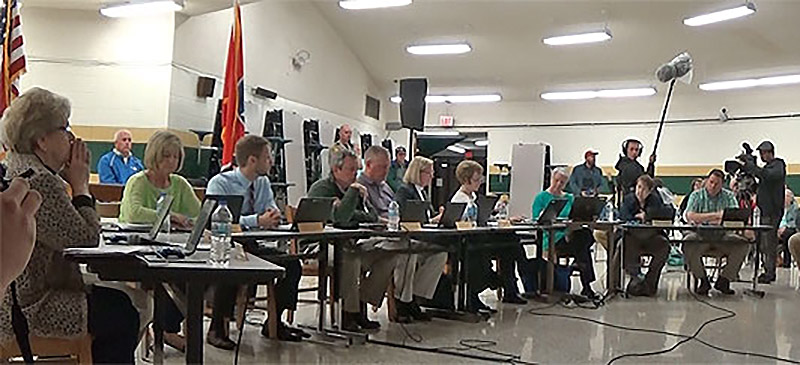 On April 11, 2016, the Franklin County, TN, School Board votes to pass new "hard" regulations for all school clubs in order to stop the GSA club — instead of confronting the Equal Access Act. So the action unfortunately wasn't effective. [MassResistance photo]
Given the offensive activities and destructive effects that GSA clubs have in schools, it’s not a surprise that many school officials, parents, and community members don’t want them in their sschools.
GSAs – now variously called “Gay Straight Alliance” or “Genders & Sexualities Alliance” clubs – actively push both sexual orientation and transgender identity propaganda on schoolchildren from elementary school through high school.
But when the existence of a GSA in a public school is challenged, the aggressive answer by LGBT movement’s legal groups, including the ACLU, is that the 1984 Equal Access Act (20 U.S. Code § 4071 – “Denial of equal access prohibited”) guarantees that the club is protected and may not be banned. Even the US Department of Education (2023, and still posted) has cited the Equal Access Act as foundational to GSAs’ legality.
Schools have been regularly threatened with severe lawsuits for violating the 1984 Act. Since the early 2000s, that tactic has been used successfully against conservative school districts across the country. And the courts have usually agreed – though it’s generally been the result of shrewd judge-shopping by the plaintiffs and unsophisticated or incompetent school district attorneys handling the cases.
Origin of the Equal Access Act – an entirely different purpose
In the early 1980s, after students in some public secondary schools were denied permission to start Christian clubs or Bible clubs, their legal challenge led to Congress passing the Equal Access Act in 1984. The purpose was to make sure schools that allow student clubs or other type of “open forums” cannot discriminate against student groups based on religious, political, philosophical, or similar viewpoints. Thus, if a school allowed any non-curriculum club, it could not single out religious clubs for exclusion. It surely did not anticipate the emergence of student clubs focused on sexuality, “gender,” and “LGBT rights,” much less BDSM, transgenderism, pornography, or the normalization of perverted sexual practices.
However, the truth is that the Equal Access Act does not protect GSAs, despite the efforts of LGBT lawyers to distort the law. A good pro-family lawyer could easily beat that intimidation.
The mistake that too many school districts make to “get around” the Act
Most school officials, school lawyers, and even pro-family lawyers use a superficial reading and analysis of the Equal Access Act to determine a “strategy” for dealing with the GSA problem. They conclude that if all school clubs are treated the same and must follow the same rules, the Act’s requirements would be fulfilled. Thus, the district can either (1) ban all clubs entirely, or (2) make strict rules that would hopefully hinder GSAs – such as requiring parents’ written permission for students to join any club.
In 2016, several alarmed parents in Franklin County, Tennessee, reached out to MassResistance for help stopping a GSA that LGBT activists had set up at the local high school. When the district’s conservative school board began to take action to remove the club, the ACLU sent them an aggressive letter threatening to sue them using the Equal Access Act.
We advised the board members that the ACLU’s threats could be successfully challenged. Instead, their lawyers advised them to institute a strict set of rules, which required all clubs to make their activities and communications public, as well as requiring parents' written approval to join.
Sadly, the new rules did not derail the GSA and it is still on the school's roster of student clubs. This, in addition to the other GSA outrages we've documented, led MassResistance to a closer examination of the actual wording of the Equal Access Act.
What the Equal Access Law really says
Here is the text of the law. Below the text are the explanations of why it does not protect GSAs. The truth is that school GSAs can easily be stopped using proper – and obvious – legal arguments.
SUBCHAPTER VIII—EQUAL ACCESS
§4071. Denial of equal access prohibited
(a) Restriction of limited open forum on basis of religious, political, philosophical, or other speech content prohibited
It shall be unlawful for any public secondary school which receives Federal financial assistance and which has a limited open forum to deny equal access or a fair opportunity to, or discriminate against, any students who wish to conduct a meeting within that limited open forum on the basis of the religious, political, philosophical, or other content of the speech at such meetings.
(b) "Limited open forum" defined
A public secondary school has a limited open forum whenever such school grants an offering to or opportunity for one or more non-curriculum related student groups to meet on school premises during noninstructional time.
(c) Fair opportunity criteria
Schools shall be deemed to offer a fair opportunity to students who wish to conduct a meeting within its limited open forum if such school uniformly provides that—
(1) the meeting is voluntary and student-initiated;
(2) there is no sponsorship of the meeting by the school, the government, or its agents or employees;
(3) employees or agents of the school or government are present at religious meetings only in a non-participatory capacity;
(4) the meeting does not materially and substantially interfere with the orderly conduct of educational activities within the school; and
(5) non-school persons may not direct, conduct, control, or regularly attend activities of student groups.
(d) Construction of subchapter with respect to certain rights
Nothing in this subchapter shall be construed to authorize the United States or any State or political subdivision thereof—
(1) to influence the form or content of any prayer or other religious activity;
(2) to require any person to participate in prayer or other religious activity;
(3) to expend public funds beyond the incidental cost of providing the space for student-initiated meetings;
(4) to compel any school agent or employee to attend a school meeting if the content of the speech at the meeting is contrary to the beliefs of the agent or employee;
(5) to sanction meetings that are otherwise unlawful;
(6) to limit the rights of groups of students which are not of a specified numerical size; or
(7) to abridge the constitutional rights of any person.
(e) Federal financial assistance to schools unaffected
Notwithstanding the availability of any other remedy under the Constitution or the laws of the United States, nothing in this subchapter shall be construed to authorize the United States to deny or withhold Federal financial assistance to any school.
(f) Authority of schools with respect to order, discipline, well-being, and attendance concerns
Nothing in this subchapter shall be construed to limit the authority of the school, its agents or employees, to maintain order and discipline on school premises, to protect the well-being of students and faculty, and to assure that attendance of students at meetings is voluntary.
(Pub. L. 98–377, title VIII, §802, Aug. 11, 1984, 98 Stat. 1302.)
Statutory Notes and Related Subsidiaries
Short Title
Pub. L. 98–377, title VIII, §801, Aug. 11, 1984, 98 Stat. 1302, provided that: "This title [enacting this subchapter] may be cited as 'The Equal Access Act'."
§4072. Definitions
As used in this subchapter—
(1) The term "secondary school" means a public school which provides secondary education as determined by State law.
(2) The term "sponsorship" includes the act of promoting, leading, or participating in a meeting. The assignment of a teacher, administrator, or other school employee to a meeting for custodial purposes does not constitute sponsorship of the meeting.
(3) The term "meeting" includes those activities of student groups which are permitted under a school's limited open forum and are not directly related to the school curriculum.
(4) The term "noninstructional time" means time set aside by the school before actual classroom instruction begins or after actual classroom instruction ends.
Here’s how the law does not protect GSAs
- Secondary schools only: Sections (a) and (b) make it clear this law applies only to secondary schools that receive federal funding. There is no mention of middle schools or elementary schools. Therefore, all middle and elementary school LGBT clubs are clearly not protected by this law. As we discuss in Part 6, there are now middle school and elementary school GSAs across the country.
- Definition of “content” does not include perversions: Note also in Section (a) that the law was passed to protect school club discussions of “religious, political, philosophical, or other speech content.” Surely, the original intent of the law could not be to allow student conversations on anal sex, lesbian sex practices, pornography, or how to get a referral for gender-transition hormones or surgeries. As we discuss in Part 4, the deviant sexual behaviors and obscene materials connected with GSAs are ghastly.
- The activity must be voluntary: Sections (c)(1) and (f) declare that the “meeting” must be “voluntary.” The law’s definitions elaborate: “The term ‘meeting’ includes those activities of student groups which are permitted under a school's limited open forum and are not directly related to the school curriculum.” As we described in Part 3, schoolwide activities pushed by GSAs (e.g., “Day of No Silence” or “Pride week/month”) are a big part of GSA activity. They target the entire student body, so are not “voluntary” for those who object.
- The clubs must be student-initiated and student-run. Section (c)(1) declares that the clubs must be student-initiated and Sections (c)(2) and (c)(5) expand on that to explain that the club must also be student-run. As we describe in Part 2, GSAs are heavily organized, planned, and equipped by national LGBT groups like GLSEN and GSA Network. These groups coordinate with a school staffer who does the organizing of the club in the school. Students are trained to act as “fronts” before the public. But unlike a Bible club, it never happens organically by students with no outside influence or help.
There are detailed guides provided for the adult GSA advisors. Training sessions are held for "student leaders." In Massachusetts and elsewhere, the states' Department of Education has staff and training devoted to promoting GSAs. The ACLU gives legal advice on how to protect GSAs. - No involvement by school employees. Section (c)(2) also states there can be “no sponsorship of the meeting by the school, the government, or its agents or employees.”
The definition in the text explains: “The term ‘sponsorship’ includes the act of promoting, leading, or participating in a meeting.” This reinforces the problem with GSAs – that they are virtually always run and organized by a radical school employee. The school administrators approving school-wide events such as "Day of Silence" could also fall under "involvement by school employees." - No involvement by non-school employees. Section (c)(5) declares “non-school persons may not direct, conduct, control, or regularly attend activities of student groups.” That would exclude speakers from outside activist groups who present lectures, run seminars or trainings for the club members, whether at the school or outside the school. Only students may determine the content (“direct”), and run (“conduct, control, or regularly attend”) meetings. GSAs regularly involve outside people in their activities. See our article on how GSAs connect students to dangerous groups and individuals.
- May not interfere with orderly conduct of educational activities. Section (c)(4) states: “the meeting does not materially and substantially interfere with the orderly conduct of educational activities within the school.” We did an entire article on how GSAs disrupt the entire school’s educational environment. In addition, community outrage and disputes over GSAs can create nasty disorder in the school.
- No public funds for GSAs. Section (d)(3) states, “Nothing in this subchapter shall be construed to authorize the United States or political subdivision thereof … to expend public funds beyond the incidental cost of providing space for student-initiated meetings.” Several states use public money to support GSA activities. Massachusetts actually has a line item in the state budget and specific functions in the state’s Department of Education for that purpose.
- Unlawful meetings not sanctioned. Section (d)(5) notes that “unlawful” meetings are not sanctioned. Since there is no statutory “obscenity exemption” for noncurricular activities recognized by a school, any GSA meeting with obscene or prurient content could be considered unlawful. (Only if the obscene sexual content is part of the official educational curriculum, as in sex ed classes, is it unfortunately exempted in law by many states.) See our article on how GSAs are pushing deviant sexual behaviors and obscene materials on students.
- May not abridge the rights of any person. Section (d)(7) says the U.S., state, or local governments may not “abridge the constitutional rights of any person.” GSAs entail special rights for LGBT students to speak on sexuality and gender issues, but anyone who objects to a GSA event or message is often denied free speech rights (by the school administrators), or feels intimidated to keep silent, Furthermore, the rights of parents (confirmed by many court rulings) to raise their children according to their values are being violated by the presence of these clubs which normalize LGBTQ “identities” to their children, contrary to their values. Parents are often denied knowledge of the club’s membership, subject matter, or schoolwide events.
Final thoughts
The negative effect of a well-organized and aggressive LGBT movement in a school cannot be overstated. It eventually reaches nearly everywhere in the school environment.
Parents and other civic-minded residents in a community have the facts and the law on their side when it comes to shutting down these offensive and dangerous GSA clubs. Unfortunately, a big impediment is the school officials themselves and the school attorneys who either support the LGBT agenda or are afraid or incompetent to fight back. As a result, the students suffer.
But it doesn’t have to be this way. We hope this helps open people’s eyes – and spur them to action!


Please help us continue to do our uncompromising work!
Our successes depend on people like you.
Your support will make the difference!


No comments:
Post a Comment